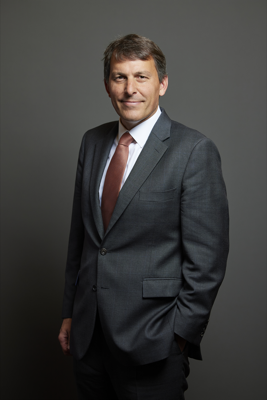
Scrutiny of the government's finances occupies much of Glen's time — but his most visible recent controversy was off the floor. Local news reported that he accepted a paid directorship despite publicly committing in July 2025 not to take secondary paid work. Columnists in the Salisbury Journal were sharp about it, describing his response to criticism as evasive. On the positive side, he secured a £3m funding boost for a local cultural institution in April 2026, drawing on his experience as a former Arts Minister.
Glen is a near-total party-line voter — 99.5% alignment with the Conservative majority — but has twice broken ranks on the Tobacco and Vapes Bill, voting at Second and Third Reading to support the generational smoking ban despite his party's majority opposing it. His participation rate of 68% is below the Commons average. His speeches cluster heavily around the economy, fiscal policy, local government, and social care, consistent with his seat on the Treasury Committee, where he engages closely with government spending and tax policy.
Beyond the directorship row, his local coverage over the past 90 days has been broadly neutral, dominated by culture-and-sport stories — largely a continuation of his advocacy for Salisbury's arts sector. His stance data shows he is strongly pro-business (94%) and pro-parliamentary scrutiny (86%), while sitting well to the right of his own party on assisted dying — 100% backing restrictions versus a 68% party average. Speech and voting data are available from 2025 onwards; earlier records in this term are limited.