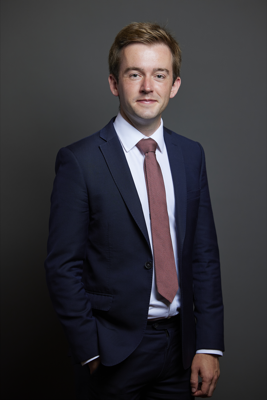
Rutland's one act of rebellion tells you something about his instincts: in December 2024 he voted for proportional representation, breaking with Labour to back a Liberal Democrat bill that would have replaced first-past-the-post with the single transferable vote. It is his only recorded rebel vote, and it came despite Labour winning two-thirds of seats on one-third of votes — the very result the bill was designed to address. Beyond that, his local record has drawn attention: he secured £4 million in flood defence funding for Adur and Worthing, joined a campaign over a dangerous school crossing in Worthing, and has been credited with sustained constituency advocacy on environmental and community issues.
At 83% voting participation — roughly in line with the Commons average — Rutland is an active parliamentary presence, with 92 contributions across 69 debates. He votes with Labour 99.8% of the time, making him effectively a party-line MP outside that single electoral reform break. His speeches cluster around the economy, defence, health, social care, and local government. His stance profile flags low alignment with pro-business (17%) and pro-civil-liberties (13%) positions, and zero alignment with anti-tax positions — consistent with the Labour mainstream. He scores notably above his party average on assisted dying access (+31 percentage points), suggesting a more permissive personal position on that issue.
No committee memberships are recorded. His news coverage over the past 90 days spans 27 articles, though average sentiment is near neutral — neither strongly positive nor negative. The highest-profile stories centre on flood defences and community projects rather than controversy. His deviations from party norms on immigration control (20% vs Labour's 33%) and child welfare (33% vs 47%) are worth noting, though the underlying vote counts are relatively small and should be interpreted with caution.