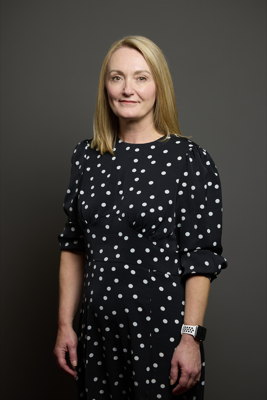
Platt's one notable act of rebellion came in January 2026, when she broke from Labour to vote against new regulations raising fees on medical device companies — joining opposition MPs who argued the charges, coming so soon after a June 2025 increase, risked squeezing smaller businesses. Beyond that, she has voted with the Labour whip on virtually every division since entering Parliament in 2024, backing the Immigration and Asylum Bill, planning reforms that remove councillor oversight of smaller housing applications, and the unwinding of the automatic preference for academies when opening new schools.
Her participation rate of 77% sits below the Commons average, though she compensates with substantial spoken activity — 106 contributions across 77 debates, led by economy and jobs, local government, and social care. She is a 99.8% party-line voter, but her stance profile flags some divergence: she backs assisted dying access notably more than the average Labour MP (89% versus 58%), is firmer against fossil-fuel subsidies, and leans harder against welfare expansion and Lords scrutiny than her parliamentary colleagues. Her voting record shows low alignment with civil liberties and pro-business positions.
Her news profile is dominated by constituency-level advocacy: intervening against misinformation during local disorder in August 2025, objecting to a development she felt threatened the local environment, and writing to the Secretary of State over Grok AI-generated sexualised images. She sits on the Culture, Media and Sport Committee and the Modernisation Committee, which helps explain the AI regulation interest and her relatively high speech count on culture and community topics. Recent local coverage (last 90 days) centres on planning and education, with sentiment data limited by a small sample.