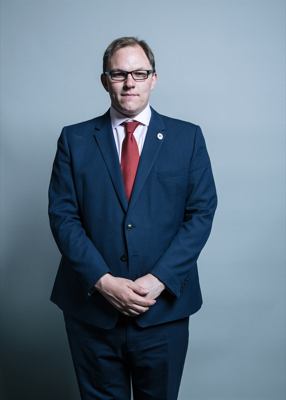
One of Labour's most loyal MPs has recently made headlines beyond Westminster. Gareth Snell has pushed publicly for government action against Iran's Revolutionary Guard Corps, called for tougher regulation of absent landlords in Stoke-on-Trent, and championed a local Small Business Awards scheme that brought a ministerial roundtable to his constituency. His one rebel vote — supporting a committee sitting in private when 73 MPs opposed it — is a minor procedural outlier rather than a sign of dissent. On substantive legislation, he has backed the government on the National Security (State Threats) Bill, including opposing amendments that would have added judicial oversight safeguards, and voted with Labour against opposition motions on defence spending.
At 86% voting participation, Snell sits slightly above the Commons average and is a 99.8% party-line voter — one of Labour's most dependable tellers. His speeches cluster heavily around economy and jobs, local government, and fiscal policy, with social care, education, and crime also featuring regularly. His stance profile marks him notably low on parliamentary scrutiny (13%), civil liberties (15%), and Lords scrutiny (0%), meaning he has consistently voted to limit rather than extend oversight mechanisms. He sits above his party's average on public health issues by 12 percentage points.
Snell sits on the Committee of Privileges, the Committee on Standards, and the Statutory Instruments Select Committee — roles concerned with parliamentary conduct and legislative oversight, which sit in some tension with his voting record on scrutiny. Local news coverage over the past 90 days is dominated by crime stories, though sentiment data is neutral across all categories, suggesting no particular controversy or praise. Data on his pre-2024 record in Stoke-on-Trent Central — he also held the seat from 2017 to 2019 — is not included here.