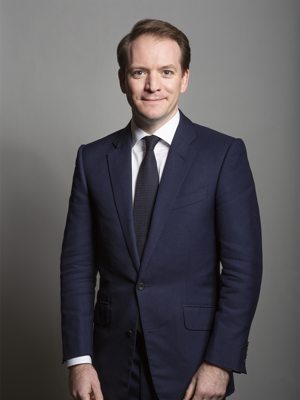
Davies has made the fight to save Prince William of Gloucester Barracks his most visible cause, launching a public petition, writing to ministers, and arguing — in local press and in the Commons — that the planned 2028 closure damages national readiness, not just the local economy. That campaign aligns with his recent voting record: he backed multiple Conservative amendments to the Armed Forces Bill, supported the opposition's defence spending motion, and voted against the government's counter-amendment on military readiness. On the National Security (State Threats) Bill, he voted to preserve judicial oversight and opposed a timetable motion that would have curtailed scrutiny — consistent with his 95% alignment on parliamentary scrutiny measures.
Davies votes with the Conservative party 100% of the time, making him one of the most loyal opposition MPs by that measure, though his participation rate of 64% sits below the Commons average. His speeches concentrate heavily on economy and fiscal policy (78 contributions between them), with energy, environment, and cost-of-living also featuring. He scores 100% against tax increases and 93% pro-business, but deviates from his party by being notably more supportive of armed forces welfare (+19 percentage points above the Conservative average) and more restrictive on assisted dying (+18pp). He is less supportive of welfare expansion than most Conservative colleagues (-15pp).
Local news over the past 90 days spans crime, community, and utilities rather than his core parliamentary themes — the barracks campaign and health lobbying (he has pushed for a community diagnostic centre in Bourne) generated his highest-impact coverage earlier in the year. He holds no select committee seat, so his scrutiny work happens primarily on the floor of the House. Speech and voting data are available through June 2026.