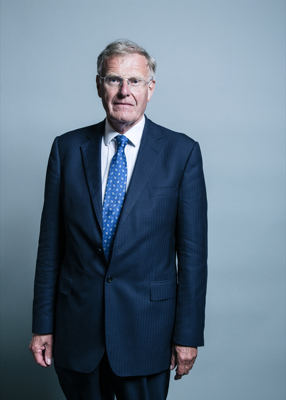
One of Westminster's most distinctive backbenchers, Christopher Chope voted against his own party in July 2026 by acting as a teller against the Conservative position on early prisoner release — one of only two rebel votes in a parliamentary record that otherwise shows near-total party loyalty at 99.2%. His more consequential recent activity has been on the National Security (State Threats) Bill, where in June 2026 he voted to oppose the government's time allocation, backed amendments to preserve judicial oversight, and supported new oversight clauses — a pattern consistent with his strong pro-parliamentary-scrutiny stance (79% aligned). He has also tabled work on Covid vaccine compensation and successfully lobbied the Department for Education to reopen a local special needs school site.
Chope's participation rate of 47% sits well below the Commons average, though his 228 contributions across 84 debates suggest he is selective rather than disengaged. His voting record is firmly conservative on tax (100% anti-tax increases, 0% pro-progressive taxation) and on Lords scrutiny (100%), but he diverges from his party by scoring notably lower on consumer protection and, historically, on crime-related votes. Economy, local government, and health dominate his speech topics. His deviations from party average are relatively small, making him a broadly reliable Conservative vote rather than a serial rebel.
The context most constituents will know is older: in 2018 and 2019 Chope blocked upskirting and FGM criminalisation bills using procedural objections, generating sustained negative coverage and a deselection petition. Recent local news — largely neutral across culture, crime, and transport stories — shows no comparable controversy. His committee memberships on Procedure and Modernisation align with his evident interest in how Parliament operates. Voting data covers 565 divisions since 1 May 1997; speech-level data is available from 2026.