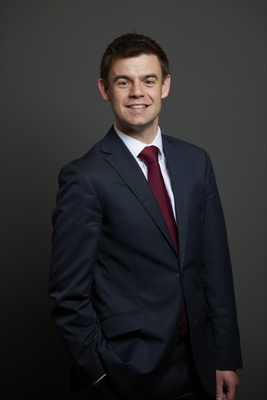
Fraud and financial crime have defined Phil Brickell's early months in Parliament. He has lobbied ministers directly for a dedicated crime-fighting fund to tackle money laundering and corruption, met with law enforcement and tech companies on fraud prevention, and used his decade of prior experience in financial crime to build a public profile on the issue — coverage in both The Bolton News and The Guardian confirms he is being taken seriously on it. He also attracted attention in January 2026 for condemning what he called Trump's attempts to "strong arm" Denmark over Greenland, a position consistent with his seat on the Foreign Affairs Committee.
Brickell votes with Labour on 99.8% of divisions — effectively a party-line MP, with one rebel vote on record: supporting a motion to sit in private that his own party opposed. His participation rate of 79% sits a little below the Commons average. His voting pattern shows strong alignment with progressive taxation and public ownership positions — he backed both the Railways Bill's third reading and the Steel Industry (Nationalisation) Bill — while his stance scores suggest he diverges from Labour on some welfare and climate votes. He speaks most frequently on the economy, defence, and local government, and deviates from his party average most sharply on pension protection and consumer rights, where he votes more supportively than most Labour colleagues.
His Foreign Affairs Committee role helps explain the volume of defence-related contributions — 62 debates — which is unusually high for a backbencher without a defence brief. Local news sentiment is broadly neutral across 88 articles in the past 90 days, with economy and jobs coverage carrying the most positive tone. His Guardian piece on the University of Greater Manchester — criticising the regulator as "asleep at the wheel" — is the most prominent signal of willingness to pressure institutions beyond Westminster.