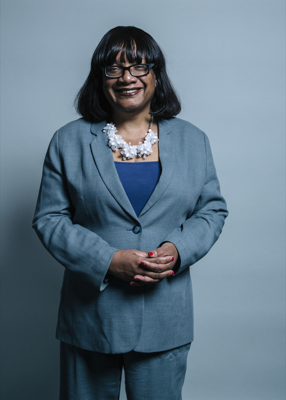
Sitting as an independent after her prolonged dispute with Labour, Diane Abbott made headlines in April 2026 by backing the cross-party motion to refer Prime Minister Keir Starmer to the Privileges Committee over claims he misled Parliament on the Peter Mandelson appointment. Her most distinctive recent cluster of votes came in March 2026 on the Victims and Courts Bill, where she sided with the Labour government against Lords amendments on free court transcripts, victim notification duties, and support for bereaved families of Britons killed abroad — placing her with a party that withdrew the whip from her just two years ago.
Abbott votes in roughly half of all Commons divisions — below the typical rate — and aligns with the independent majority on about 70% of votes, making her a selective rather than tribal parliamentarian. Her 64 speeches since the 2024 election range across defence, crime, social care, and fiscal policy; she opposed the welfare reform bill on behalf of disabled constituents and has consistently voted against cuts to benefits. Her stance scores tell a clear story: she never backs tax cuts (0% anti-tax alignment) and always supports progressive taxation (100%), but scores just 11% on tough-on-crime measures and 15% on victims' rights votes — the latter explained partly by her pro-government stance on the Victims and Courts Bill.
The Hackney North context matters here. Abbott has represented the seat since 1987, becoming Britain's first Black female MP, and local news coverage from 2024 shows strong constituent loyalty during her suspension battle with Labour. Recent 90-day news coverage spans 44 articles across culture, crime, and housing, though sentiment data yields no clear positive or negative signal. She holds no committee seats, limiting her formal scrutiny role.