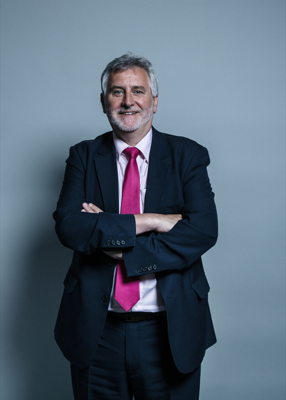
Clive Efford's most significant recent act was breaking with Labour on welfare — one of only a handful of Labour MPs to vote against the Universal Credit and Personal Independence Payment Bill at Second Reading in July 2025, and to support the reasoned amendment seeking to block it. That rebellion, on cuts to disability benefits, stands out sharply against his otherwise near-total party loyalty of 99.5%. His stance tracks his widest deviation from Labour's parliamentary average: where the party votes 90% in favour of welfare reform, Efford sits at 33%.
Beyond that rebellion, he is a steady, engaged parliamentarian. At 77% voting participation he sits a little below the Commons average, but has made 243 contributions across 159 debates — a high speech-to-vote ratio suggesting he picks his moments to speak rather than vote. He speaks most frequently on the economy, social care, local government, health, and defence, and chairs the Select Committee on the Armed Forces Bill. His stances lean strongly towards workers' rights (85%) and progressive taxation (100%), while he scores low on parliamentary scrutiny measures (11%) and consistently opposes Lords amendments (0%).
Local news coverage over the past two years gives a mixed picture. He drew positive national attention for pressing the government at PMQs over the infected blood compensation scheme, securing a direct commitment from the Prime Minister for further meetings. On the other hand, local Conservatives publicly criticised him for staying silent when Coldharbour Police Base faced closure — though the base was ultimately saved. Recent local coverage is dominated by housing and green belt concerns. Voting and speech data are drawn from the public parliamentary record.