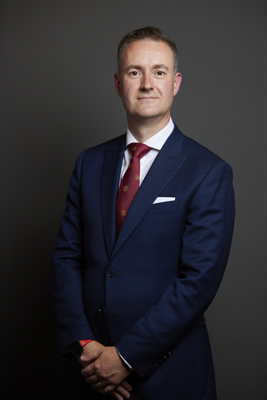
Chris McDonald's most notable recent actions were on assisted dying. On 20 June 2025, he broke with the majority of Labour MPs across five separate votes on the Terminally Ill Adults (End of Life) Bill — backing stricter safeguards that would have blocked applications where the wish to die was substantially driven by not wanting to be a burden, a mental disorder, a disability, or financial hardship. He also voted against an amendment requiring an assessment of palliative care services in the first annual report on the law. His voting profile shows him among the more sceptical Labour MPs on assisted dying access, running 44 percentage points below his party's average on that measure.
Beyond that cluster of rebel votes, McDonald is a 97.8% party-line voter who participates in 78% of divisions — slightly below the Commons average. His speeches concentrate heavily on the economy and jobs (106 contributions), energy (49), and defence (46), consistent with the industrial character of Teesside. He consistently backs workers' rights and progressive taxation, and supports the government's climate agenda. His scores on civil liberties (10%) and parliamentary scrutiny (16%) suggest he rarely backs measures that cut against executive authority.
McDonald was appointed to a ministerial role at the energy ministry in September 2025, focused on hydrogen, industrial decarbonisation, and carbon capture and storage — policy areas directly relevant to Teesside's industrial base. Before politics, he led the Materials Processing Institute, which contextualises both his economic speech focus and his reported role in securing a £100 million government intervention to reopen a mothballed Stockton biofuel plant in early 2026. He sits on no select committees. Recent local news coverage is dominated by crime and community issues, with broadly neutral sentiment.