What assessment has his department made of the potential merits of injecting landfill gas biomethane directly into the grid rather than burning it for electricity on site, in the context of the situation in the Gulf.
Awaiting answer.
Conservative and Unionist Party MP for West Aberdeenshire and Kincardine.
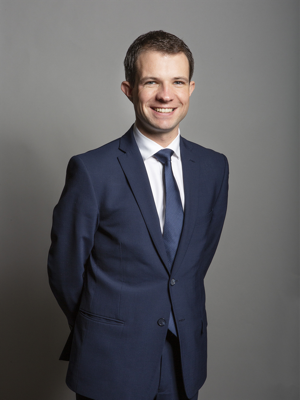
Bowie's most visible recent move was leading Conservative pressure for a Commons vote on new North Sea oil and gas licences in March, using his role as Shadow Scottish Secretary to put the government on the record over a policy with direct consequences for his constituency's economy. That activism fits a broader pattern: he voted against the Railways Bill's renationalisation model in June, backed amendments protecting veteran railcard discounts in statute, and opposed the pace of English farm subsidy cuts — all positions consistent with a pro-business, pro-armed-forces Conservative line. Earlier in the year, he attracted national coverage by writing to ministers and the First Minister demanding military deployment to clear snow from cut-off Aberdeenshire communities.
A 100% party-line voter with no rebel votes on record, Bowie is a loyal Conservative, though his participation rate of 62% sits below the Commons average. His speech activity clusters heavily around energy and economy-and-jobs — 86 contributions each — reflecting the North Sea's centrality to his constituency. He votes consistently against tax increases and with business interests (94%), and scores higher than his party average on pension protection and criminal justice reform, though he is notably more sceptical of assisted dying than most Conservative colleagues.
Bowie sits on no select committees, so his influence runs primarily through frontbench opposition work and chamber speeches rather than scrutiny roles. News coverage over the past 90 days skews towards economy and jobs issues, with broadly neutral to positive sentiment. Speech and voting data are available through June 2026; committee and ministerial records reflect his current position on the opposition frontbench as Shadow Scottish Secretary.
Andrew Bowie is the Conservative MP for West Aberdeenshire and Kincardine, and has been an MP continually since 8 June 2017. He currently undertakes the roles of Shadow Minister (Energy Security and Net Zero), and Shadow Secretary of State for Scotland.
Top eight by total divisions voted, this parliament. Volume measures engagement, not direction — see Notable Votes for free-vote moments and rebellions.
Source · The Public Whip · Hansard
Moments where the whip was free, or where Bowie broke ranks. Free votes are the truer signal of personal stance.
No rebellions or free votes recorded yet.
Source · Hansard
“Welcomed Labour's firm commitment against a referendum and sought guarantee that the government will reject any moves toward breaking up the Union.”
“Devolution has failed under SNP mismanagement; the UK Government should not devolve further powers and should scrutinise how the SNP exercises current authority.”
“Nuclear is welcome and necessary, but Labour's ambition is inadequate compared to the Conservatives' previous commitment to gigawatt-scale reactors and 25% nuclear generation; the …”
“Welcomes the amendment to keep existing nuclear online but attacks Government for cancelling Wylfa and failing to commit to new gigawatt-scale nuclear, which the Conservatives pled…”
Bowie holds no select-committee seat this session. New 2024-intake MPs typically wait one term before being appointed.
| Department | Qs | Share |
|---|---|---|
| Department for Energy Security and Net Zero | 227 | 46.0% |
| Scotland Office | 109 | 22.1% |
| Ministry of Defence | 53 | 10.7% |
| Treasury | 52 | 10.5% |
| Department for Transport | 12 | 2.4% |
| Department for Business and Trade | 10 | 2.0% |
| Department for Work and Pensions | 7 | 1.4% |
| Department for Environment, Food and Rural Affairs | 7 | 1.4% |
What assessment has his department made of the potential merits of injecting landfill gas biomethane directly into the grid rather than burning it for electricity on site, in the context of the situation in the Gulf.
Awaiting answer.
Whether the Government plans to support electricity generation from landfill gas at large landfills where the RO accreditation is due to expire in March 2027.
Awaiting answer.
What assessment her Department has made of the potential impact of the proposed transfer of anti-money laundering supervision from the Law Society of Scotland to the Financial Conduct Authority on (a) the conveyancing system, (b) legal professional privilege, (c) the criminal justice system and d) partnership law in Scotland.
Awaiting answer.
Whether she has made an assessment of the potential impact of the transfer of anti-money laundering supervisory responsibilities from the Law Society of Scotland to the Financial Conduct Authority on the regulatory responsibilities of high-street law firms in Scotland.
Awaiting answer.
Alasdair J D Locke £20,000 to cover the cost of salary for a member of staff |
Stockholm Chamber of Commerce Name of donor: Stockholm Chamber of Commerce
Address of donor: Regeringsgatan 29, 111 53 Stockholm
Estimate of the probable value (or amou… |
Conservative Friends of Israel Ltd Name of donor: Conservative Friends of Israel Ltd
Address of donor: Conservative Friends of Israel Ltd, PO Box 72288, London SW1P 9LB
Esti… |
Unpaid director of Conservative Union Research Unit Ltd, which will provide rese Unpaid director of Conservative Union Research Unit Ltd, which will provide research and briefings to Members on topics related to strengthe… |
Vice-Chairman of the Conservative Party.
Vice-Chairman of the Conservative Party.
Date interest arose: 28 July 2019
(Registered 11 January 2021; updated 30 July 2021) |
Source · Members API · Last amended 19 May 2026
| Category | £ | Share |
|---|---|---|
| Staffing | 241,233 | 71.1% |
| Accommodation | 28,704 | 8.5% |
| Office Costs | 26,851 | 7.9% |
| MP Travel | 23,958 | 7.1% |
| Staff Travel | 16,929 | 5.0% |
| Total · 109 claims | 339,116 | 100% |
Source · IPSA · FY 24_25
Nothing tabled for Bowie on the published Order Paper this week.
| Year | Constituency | Votes | Share | Result |
|---|---|---|---|---|
| 2024 | West Aberdeenshire and Kincardine | 17,428 | 35.6% | Won |
| 2019 | West Aberdeenshire and Kincardine | 22,752 | 42.6% | Won |
| 2017 | West Aberdeenshire and Kincardine | 24,704 | 47.9% | Won |
| Candidate | Votes | % | |
|---|---|---|---|
| Andrew BowieWON | Con | 17,428 | 35.6 |
Showing the MP’s own row only. Full result table: see West Aberdeenshire and Kincardine →